
Genogram symbols are standardized shapes and lines used to represent family members and their relationships. The basic symbols are: square = male, circle = female, and a question mark (?) = unknown sex (McGoldrick's 2020 edition adds a combined square-circle "dome" symbol for a non-binary person). An X through any shape indicates deceased. Relationship lines connect symbols: solid line = marriage, dashed line = engagement, zigzag line = conflict. These symbols were established by Murray Bowen (1978) and standardized by McGoldrick, Gerson, and Petry (1985, 2008).
Below is a complete reference of all genogram symbols organized by category. For in-depth explanations with clinical context, see our detailed symbols guide. Ready to put them to use? Open our free genogram maker.
Gender Symbols
The fundamental symbols representing individuals in a genogram.
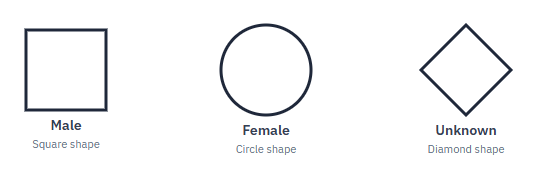
| Symbol | Shape | Meaning | Notes |
|---|---|---|---|
| Square | Male | Standard size 30px in WebGeno | |
| Circle | Female | Standard size 30px in WebGeno | |
| ? | Question mark | Unknown sex | Used when sex is not known or not specified |
| Dome (square base, circular top) | Non-binary | McGoldrick's "modified gender symbol" (4th ed., 2020) | |
| Square with inner circle | Transgender man | Outer shape shows lived gender; the inner shape notes sex assigned at birth | |
| Circle with inner square | Transgender woman | Same convention: the outer shape always shows lived gender | |
| Inverted triangle inside symbol | Sexual orientation | Gay, lesbian, bisexual, queer, or asexual orientation (McGoldrick, 2020). WebGeno does not draw this marker; use annotations instead |
How WebGeno draws these: squares, circles, the non-binary dome and the transgender shape-in-shape symbols follow McGoldrick's 4th edition exactly; unknown sex is drawn as a diamond with a "?" inside (the book defines no unknown-sex symbol, so we follow the common "?" convention). A transgender person is drawn by their lived gender; recording their gender history in the edit dialog adds the standard inner shape. You can also add a free-text identity label in the person's own words, shown under their name. See them all in the Symbols Showcase example.
Life Status Symbols
Indicators showing whether a person is living, deceased, or represents a pregnancy outcome.
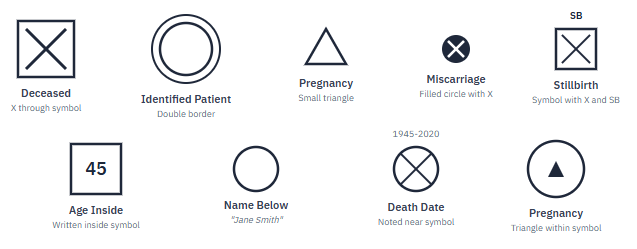
| Symbol | Indicator | Meaning | Description |
|---|---|---|---|
| Plain shape | Living | Default status for family members | |
| X through shape | Deceased | Death date often noted nearby | |
| ? inside shape | Current Pregnancy | Unborn child, gender may be unknown | |
| Small shape | Miscarriage | Spontaneous pregnancy loss (10px size) | |
| Small shape + X + "SB" | Stillbirth | Loss at or after 20 weeks | |
| Small shape + X | Abortion | Induced termination |
Couple Relationship Symbols
Horizontal lines connecting partners to show relationship type and status.

Formal Relationships (thicker 2px lines)
| Line Style | Meaning | Modifiers |
|---|---|---|
| Marriage | Can add: separation (1 slash), divorce (2 slashes), widowed | |
| Engagement | Formal commitment before marriage | |
| Union in Fact | Cohabitation / common-law partnership |
Informal Relationships (thinner 1px lines)
| Line Style | Meaning | Notes |
|---|---|---|
| Dating | Committed dating relationship | |
| Casual | Uncommitted relationship | |
| One-Night Stand | Brief encounter | |
| Love Affair | Extramarital or secret relationship |
Relationship Modifiers
| Modifier | Appearance | Meaning |
|---|---|---|
| Single slash / | Separation - couple living apart | |
| Double slash // | Divorce - legally dissolved | |
| X symbol | Widowed - spouse deceased |
Parent-Child Connection Symbols
Vertical lines connecting parents to children, showing how the child joined the family.
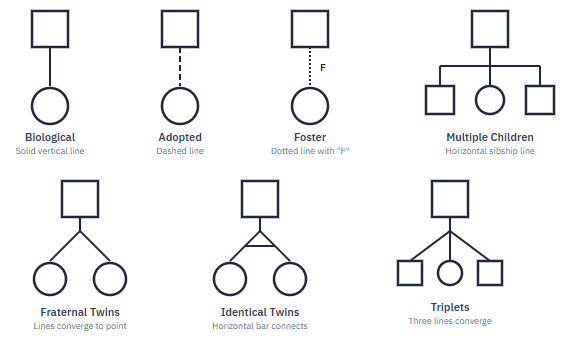
| Line Style | Child Type | Description |
|---|---|---|
| Biological | Child born to parents (default) | |
| Adopted | Legally adopted child | |
| Foster | Foster child (labeled "F") | |
| Guardian | Legal guardianship (labeled "G") |
Twin Notation
| Notation | Meaning |
|---|---|
| Two lines converging to single point | Fraternal Twins - non-identical |
| Converging lines + horizontal bar | Identical Twins - monozygotic |
Emotional Relationship Symbols
Lines showing the quality and nature of relationships between any two family members. Developed by McGoldrick et al. as the "gold standard" for genogram practice (Butler, 2008).
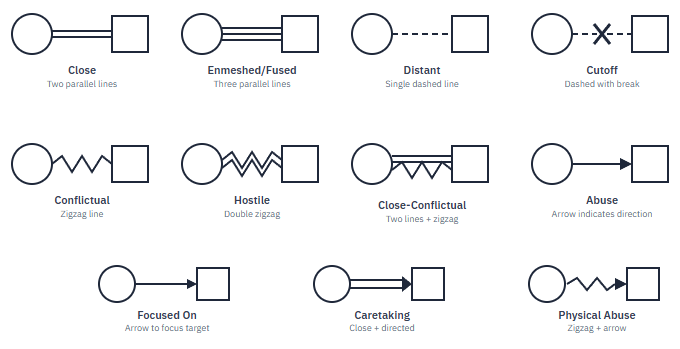
| Line Style | Relationship | Description |
|---|---|---|
| Connected | Single solid line - the two people are connected | |
| Close / Harmonious | Two parallel lines - positive connection | |
| Very Close / Enmeshed | Three parallel lines - overly close | |
| Distant | Dotted line - emotionally distant | |
| Cutoff / Estranged | Line broken by two bars - no contact | |
| Cutoff Repaired | Cutoff bars with a small circle between them - a previously severed relationship, reconciled | |
| Conflict / Discord | Zigzag line - ongoing conflict | |
| Close and Conflictual | Parallel + zigzag - fused relationship | |
| Focused On | Line with a large filled arrowhead toward the focus of attention | |
| Focused On Negatively | Small zigzag drawn through a straight line, filled arrowhead - negative attention (distinct from abuse) | |
| Caretaker | Line ending in a double open chevron pointing at the person receiving care | |
| Physical Abuse | Zigzag with filled arrowhead - points at the abused person | |
| Emotional Abuse | Zigzag with open arrowhead - points at the abused person | |
| Sexual Abuse | Zigzag between two parallel lines, arrowhead at the abused person |
Health Condition Symbols
Genograms track hereditary and significant health conditions. The quadrant system divides the symbol into sections for different condition categories.
WebGeno's Quadrant System
Traditional genogram practice uses shading or filling to indicate health conditions. WebGeno implements its own quadrant-based system for clear visual organization:
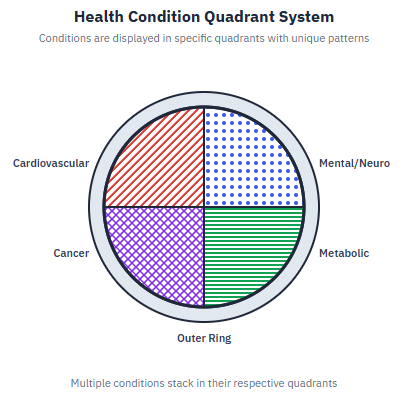
| Position | Category | Example Conditions |
|---|---|---|
| Top-Left | Cardiovascular | Heart disease, hypertension, stroke |
| Top-Right | Mental / Neurological | Depression, anxiety, bipolar, dementia, ADHD |
| Bottom-Left | Cancer | Breast, colon, lung, prostate, ovarian |
| Bottom-Right | Metabolic / Endocrine | Diabetes, thyroid disorders, obesity |
| Outer Ring | Other Categories | Respiratory, autoimmune, musculoskeletal |
Note: This quadrant layout and outer ring are WebGeno's implementation. WebGeno uses 21 distinct visual patterns (stripes, dots, crosshatch, etc.) to differentiate conditions, ensuring clarity in both color and black-and-white printing. See our features page for details on the 64 predefined conditions.
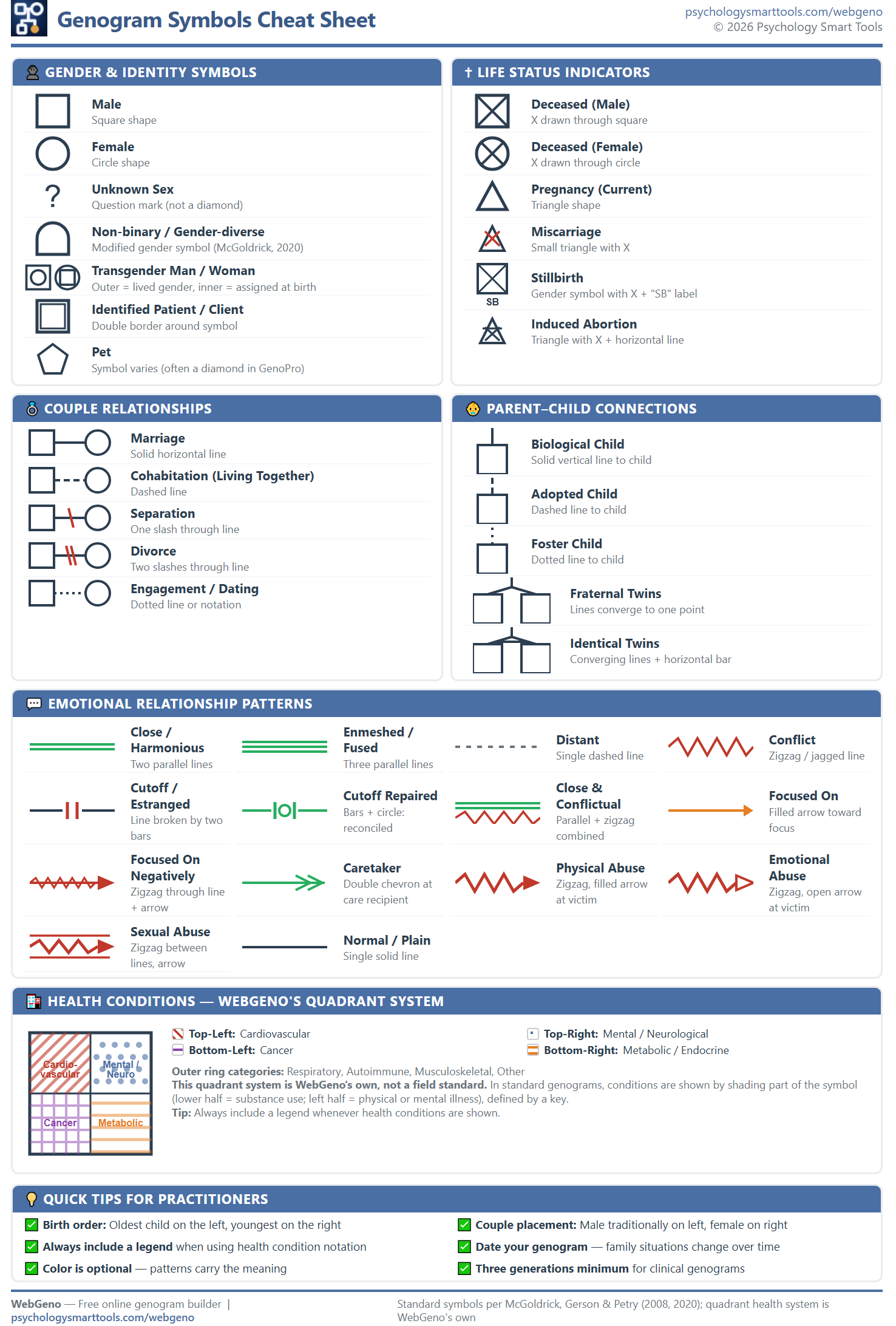
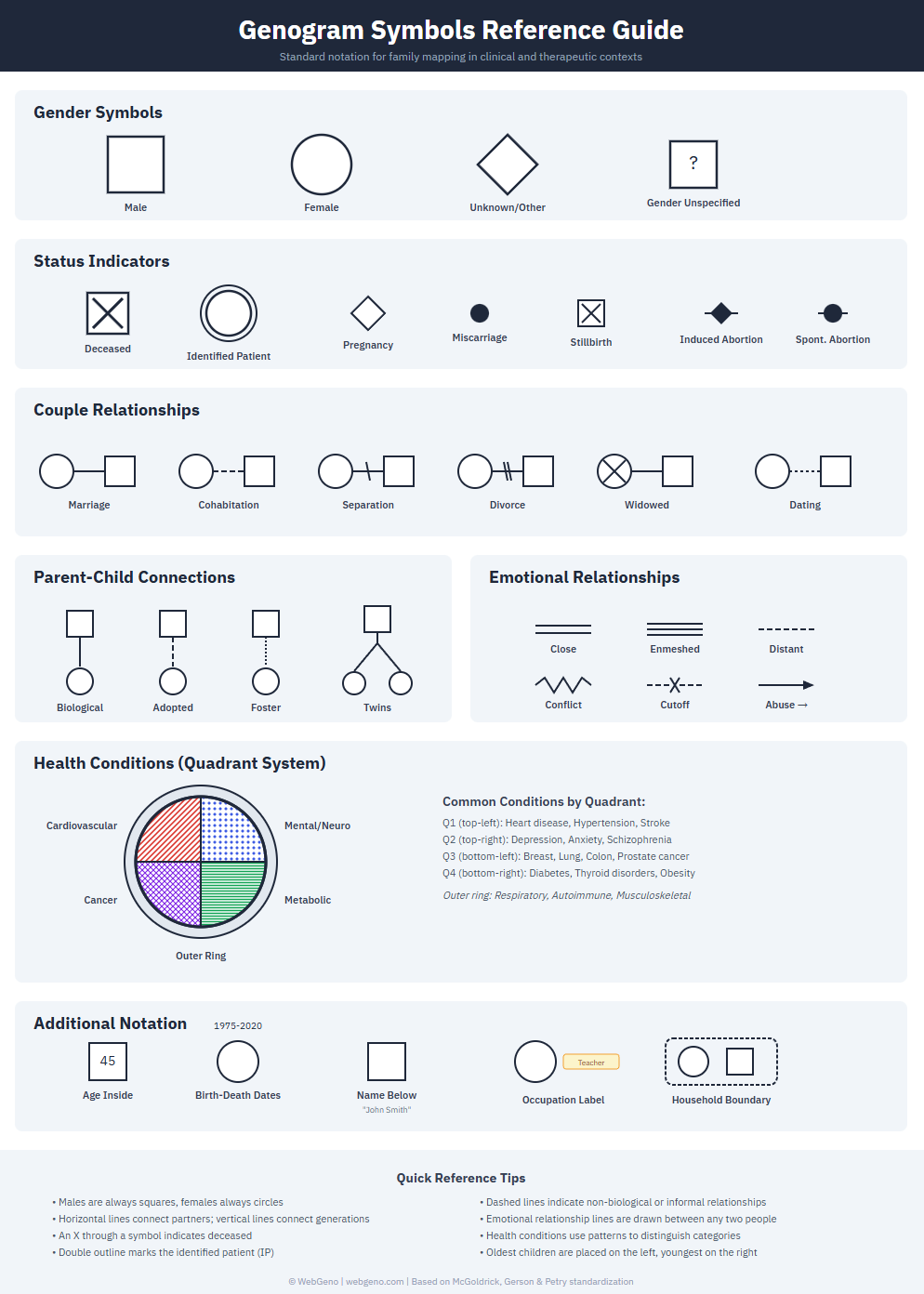
Complete Symbol Chart
All standard genogram symbols on a single reference chart. Right-click to save it, or grab the cheat sheet as a printable PDF or PNG image.
References & Standards
Genogram symbols are based on established clinical standards:
- Bowen, M. (1978). Family therapy in clinical practice. Jason Aronson. - Established foundational genogram concepts
- McGoldrick, M., Gerson, R., & Petry, S. (2008). Genograms: Assessment and intervention (3rd ed.). W. W. Norton. - The primary reference for genogram notation
- McGoldrick, M., Gerson, R., & Petry, S. (2020). Genograms: Assessment and treatment (4th ed.). W. W. Norton. - Updated edition covering gender-diverse and modern family structures
- Butler, J. F. (2008). The family diagram and genogram: Comparisons and contrasts. The American Journal of Family Therapy, 36(3), 169-180.
- Piasecka, K., Slusarska, B., & Drop, B. (2018). Genograms in nursing education and practice. Journal of Community Medicine & Health Education, 8(6), 640.
Create Genograms with Standard Notation
WebGeno includes all standard symbols with an intuitive interface. Free for core features.