
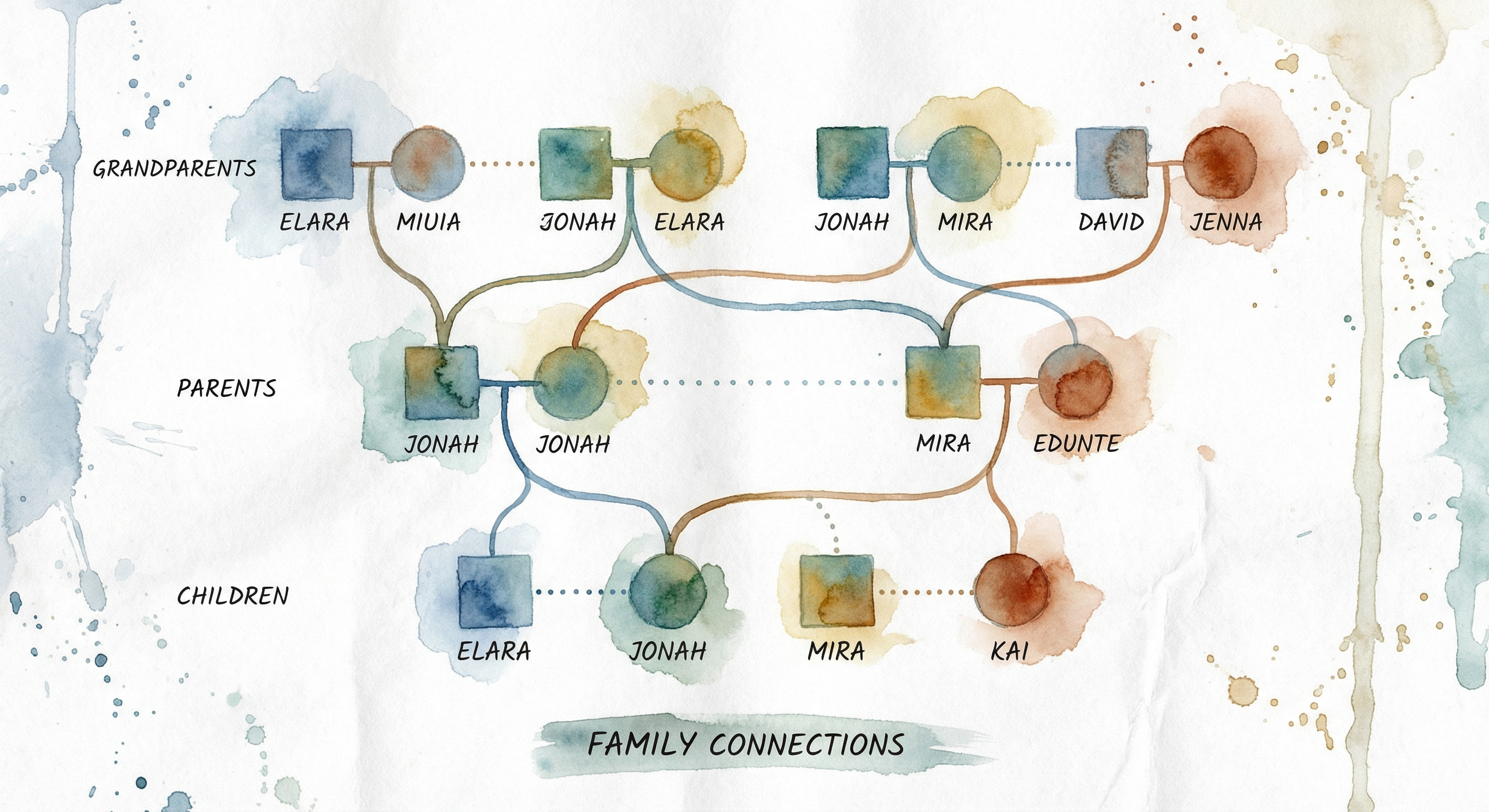
Creating a genogram might seem daunting at first, but it's actually a straightforward process when you break it down into manageable steps. Whether you're a therapist, social worker, psychology student, or counselor, this comprehensive tutorial will guide you through creating meaningful family maps that reveal generational patterns and relationship dynamics.

What is a Genogram?
A genogram is a visual representation of family relationships, patterns, and characteristics spanning multiple generations. Unlike a simple family tree, genograms include emotional relationships, health conditions, behavioral patterns, and significant life events that affect family functioning.
Developed in the 1950s by psychiatrist Murray Bowen and later popularized by Monica McGoldrick, genograms have become essential tools in family therapy, social work, and healthcare. To understand the full background of this powerful assessment tool, read our complete history of genograms.
What You'll Need
The beauty of genogram creation lies in its simplicity. You have two main options:
Digital Option (Recommended)
- WebGeno - Free, browser-based genogram builder
- No software installation required
- Professional symbols and formatting
- Save and export capabilities
- Automatic legend generation
Traditional Option
- Large sheet of paper (11x17 or larger recommended)
- Pencils and erasers
- Ruler for clean lines
- Reference guide for standard genogram symbols
For this tutorial, we'll use examples from both approaches, but the steps remain the same regardless of your chosen method.
Step 1: Identify the Index Person
Every genogram starts with the index person—the individual who is the focus of your assessment. This is typically your client, patient, or the person seeking services.
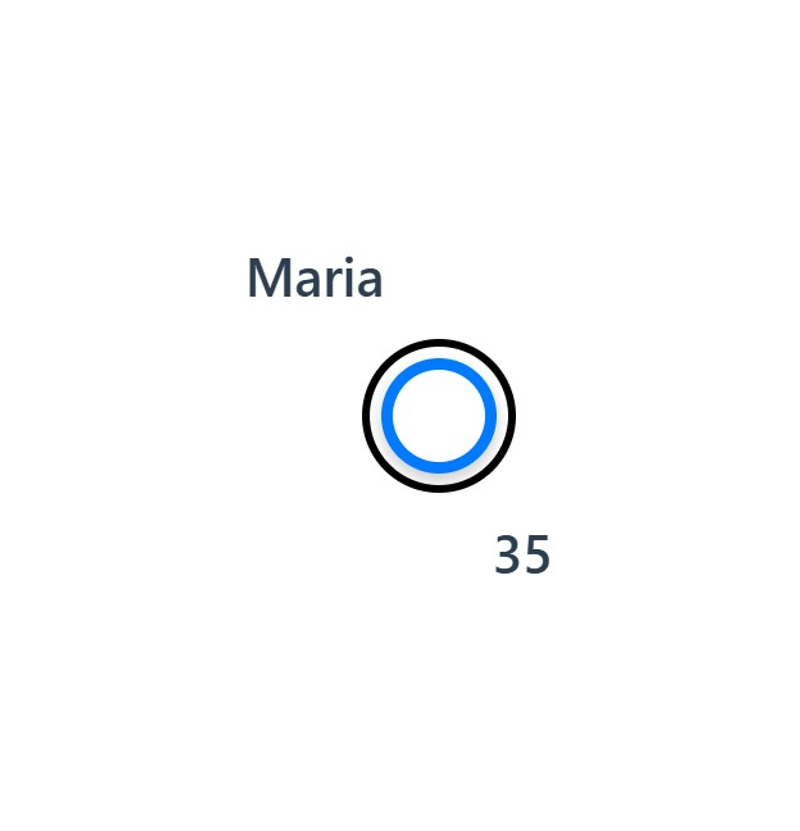
Let's use an example: Imagine Maria, a 35-year-old woman seeking therapy for anxiety and relationship difficulties. Maria becomes our index person and will be positioned centrally in our genogram.
Positioning Guidelines
- Place the index person in the center of your genogram
- Use appropriate gender symbols: square for male, circle for female
- Include age and name inside or adjacent to the symbol
- Consider using different colors or line weights to highlight the index person
Clinical Considerations
The choice of index person affects your entire assessment. Sometimes you may need multiple genograms for different family members, especially in family therapy where perspectives and experiences vary significantly.
Step 2: Map the Nuclear Family
Once you've established your index person, build outward to include their immediate family: parents, siblings, spouses, and children.
Parents and Parental Generation
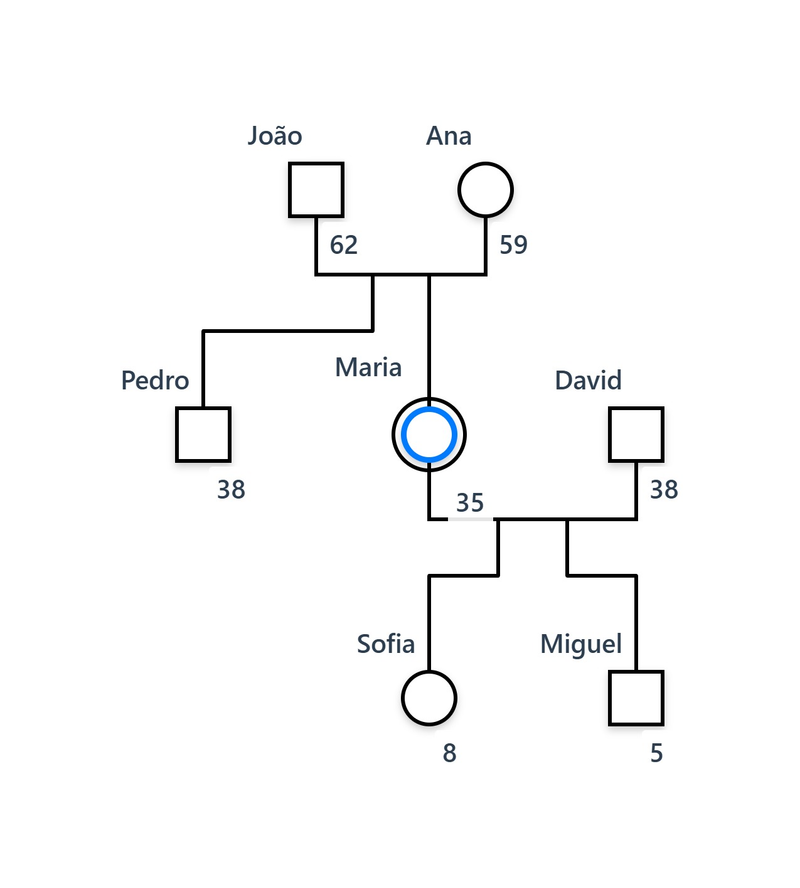
Position parents above the index person:
- Father on the left, mother on the right (conventional positioning)
- Connect with a horizontal marriage line
- Include ages, dates of birth/death, and key identifying information
Siblings
Arrange siblings from oldest to youngest, left to right:
- Connect all siblings to the parental marriage line
- Use vertical lines to show parent-child relationships
- Clearly mark birth order
Partners and Children
For the index person's current relationships:
- Position spouse/partner at the same horizontal level
- Show children below the couple
- Include step-relationships and adoption where relevant
In Maria's case, she might be married to David (38) with two children: Sofia (8) and Miguel (5).
Step 3: Add Extended Family
Now expand to include 2-3 generations of extended family. This is where patterns across generations often become visible.
Grandparent Generation
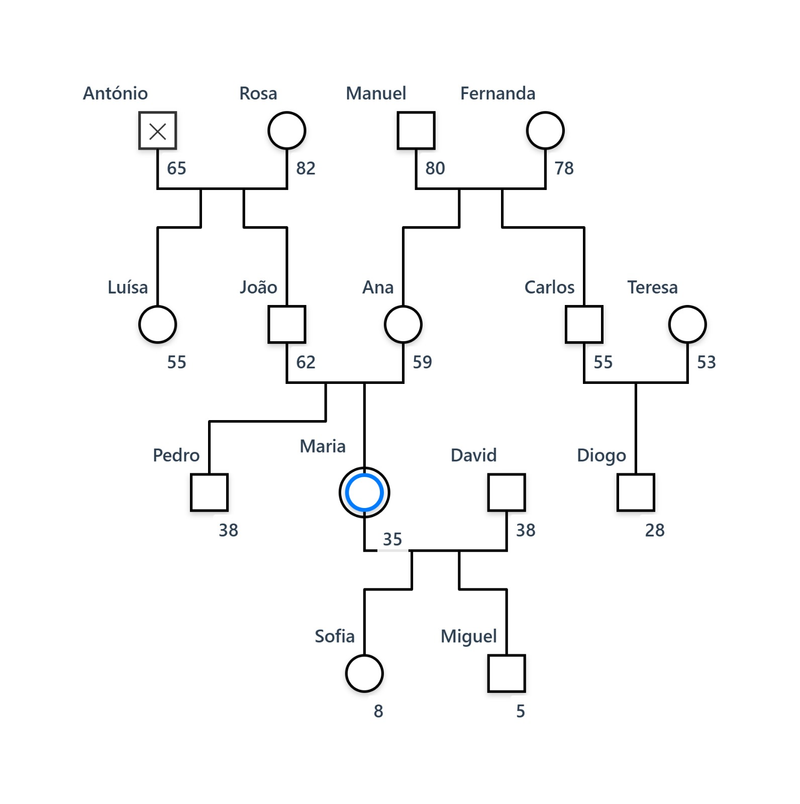
Add both sets of grandparents above the parental generation:
- Maternal grandparents above the mother
- Paternal grandparents above the father
- Include available information about their relationships and characteristics
Aunts, Uncles, and Cousins
Include siblings of parents and their families:
- Position at the same level as the parental generation
- Show their children (the index person's cousins) at the sibling level
- Focus on family members most relevant to current issues
Deciding What to Include
Not all family members need equal detail. Focus on:
- Family members with significant influence on the index person
- Those involved in current issues or conflicts
- People who represent important family patterns or themes
- Individuals with relevant health or mental health conditions
Want to follow along?
Open WebGeno and build your genogram as you read — free, no sign up required.
Open WebGeno →Step 4: Add Relationship Lines
Now that you have the family structure mapped, it's time to show the nature of relationships between family members.
Marital and Partnership Relationships
- Marriage: Solid horizontal line between partners
- Divorce: Marriage line with two diagonal slashes through it
- Separation: Marriage line with one diagonal slash
- Cohabitation: Dashed horizontal line
- Engagement: Dotted horizontal line
Multiple Relationships
When individuals have had multiple marriages or significant relationships:
- Show all significant relationships chronologically
- Include dates when known
- Use consistent positioning (most recent relationships closer to the person)
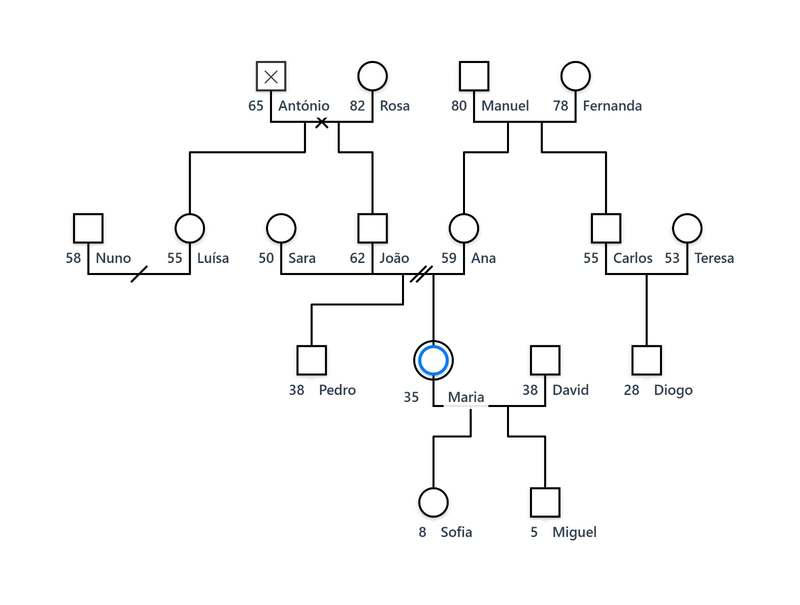
In our example, perhaps Maria's parents divorced when she was 12, and her father later remarried. Her mother remained single. These relationship changes would be clearly marked with appropriate symbols and dates.
Parent-Child Relationships
Different types of parent-child connections require different symbols:
- Biological: Solid vertical line
- Adopted: Dashed vertical line
- Foster: Dotted vertical line
- Twins: Connected horizontal bracket above vertical lines
Step 5: Add Emotional Relationships
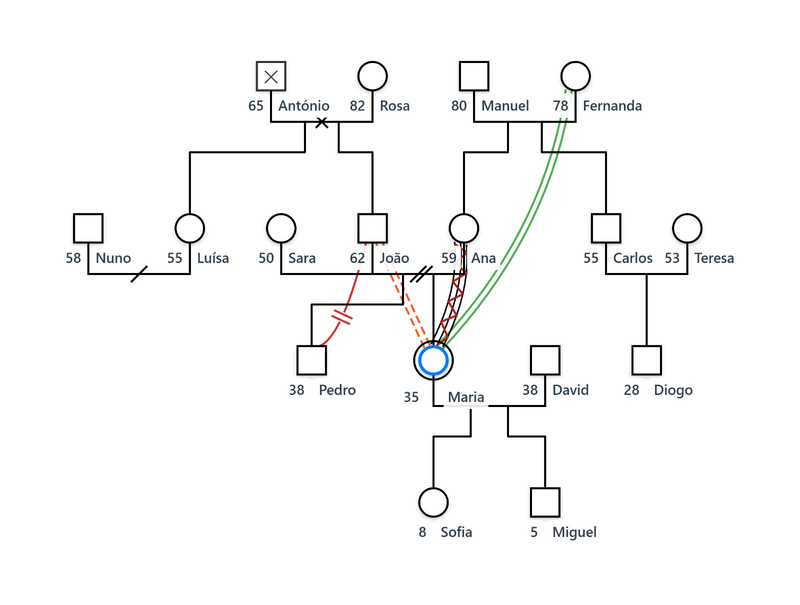
This step brings your genogram to life by showing the emotional quality of family relationships. These patterns often reveal important therapeutic targets.
Types of Emotional Relationships
Close or Loving Relationships
- Symbol: Three parallel lines between individuals
- Indicates: Mutual affection, support, and positive connection
- Example: Maria might have a particularly close relationship with her maternal grandmother
Conflicted Relationships
- Symbol: Zigzag or jagged line
- Indicates: Ongoing tension, arguments, or unresolved issues
- Example: Maria and her father might have a strained relationship since the divorce
Cutoff Relationships
- Symbol: Broken or interrupted line
- Indicates: Little or no contact, emotional disconnection
- Example: Maria's older brother might have no contact with their father
Enmeshed Relationships
- Symbol: Multiple connecting lines or boundary around individuals
- Indicates: Overly close boundaries, difficulty with individual identity
- Example: Maria might have an enmeshed relationship with her mother
Clinical Application
As you add emotional relationships, patterns often emerge:
- Triangulation (three-person relationship dynamics)
- Generational patterns of conflict or closeness
- Family roles (mediator, scapegoat, caretaker)
- Boundaries and differentiation issues
Step 6: Add Health Conditions & Life Events
Medical conditions, mental health issues, substance use, and significant life events provide crucial context for understanding family patterns and potential risk factors.
Health Conditions
Physical Health
- Chronic illnesses (diabetes, heart disease, cancer)
- Genetic conditions
- Cause of death information
- Current health status
Mental Health
- Depression, anxiety, bipolar disorder
- Personality disorders
- Suicide attempts or completions
- Hospitalization history
Substance Use
- Alcohol dependence or abuse
- Drug addiction
- Recovery status and length
- Treatment history
Significant Life Events
Include major events that shaped family dynamics:
- Immigration or major relocations
- Military service
- Financial crises or successes
- Legal issues or incarceration
- Educational achievements
- Career changes
- Trauma or abuse
Documentation Methods
There are several ways to include this information:
- Inside symbols: Brief abbreviations (D = Depression, DM = Diabetes)
- Color coding: Different colors for different types of conditions
- Attached notes: Small boxes with detailed information
- Symbol modifications: Filled symbols for severe conditions
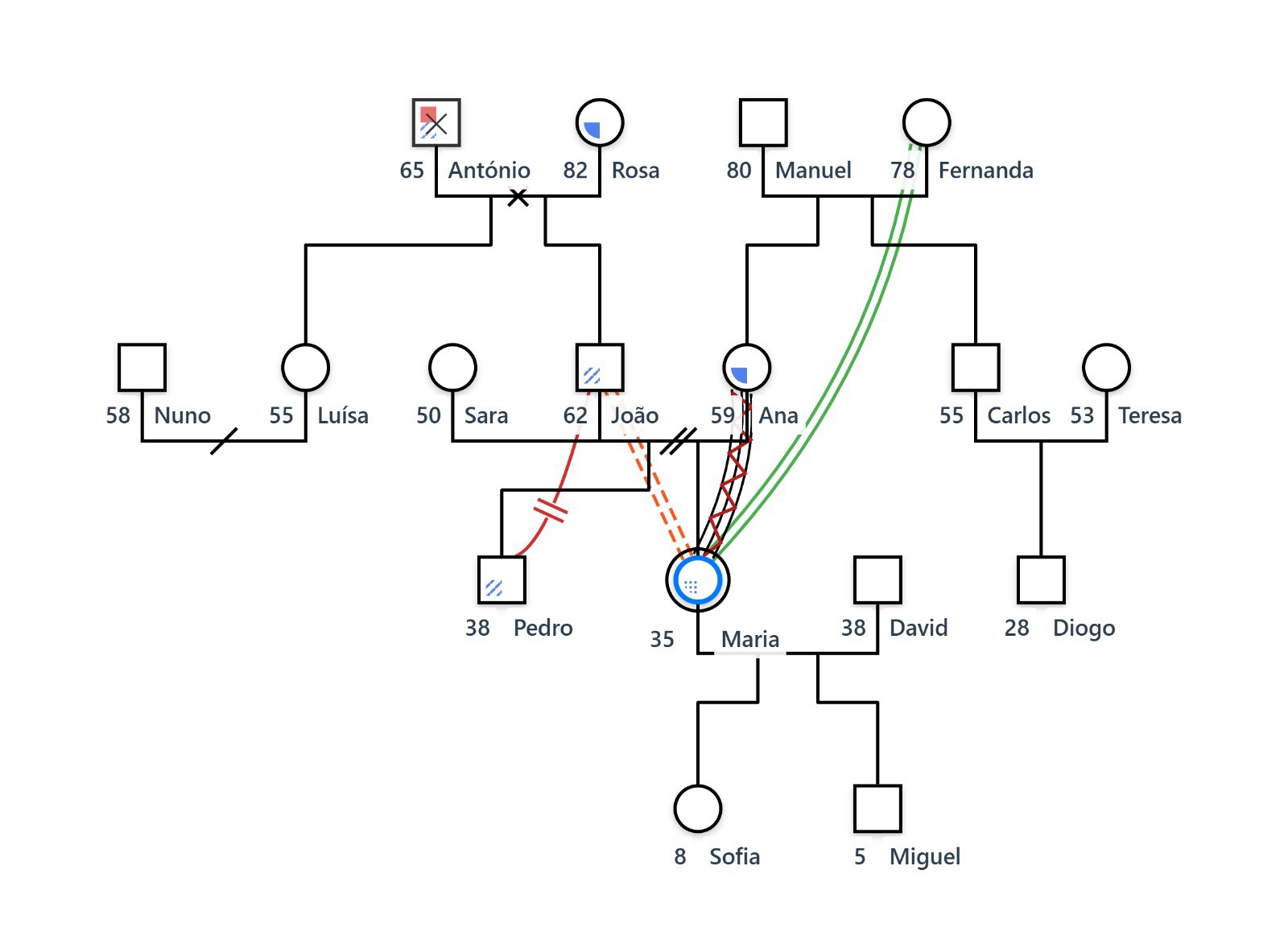
In Maria's family, we might note that her paternal grandfather died of heart disease at 65, her mother struggles with depression, and her brother has a history of substance abuse. These patterns might help understand Maria's anxiety and relationship difficulties.
Ethical Considerations
When gathering health information:
- Respect privacy boundaries
- Focus on information relevant to current issues
- Remember the genogram represents the client's subjective experience of their family — not an objective record
- Be sensitive to family secrets or shame
WebGeno tracks 64+ health conditions automatically.
Try the quadrant-based system with built-in legend generation — completely free.
Start Building →Step 7: Add the Legend
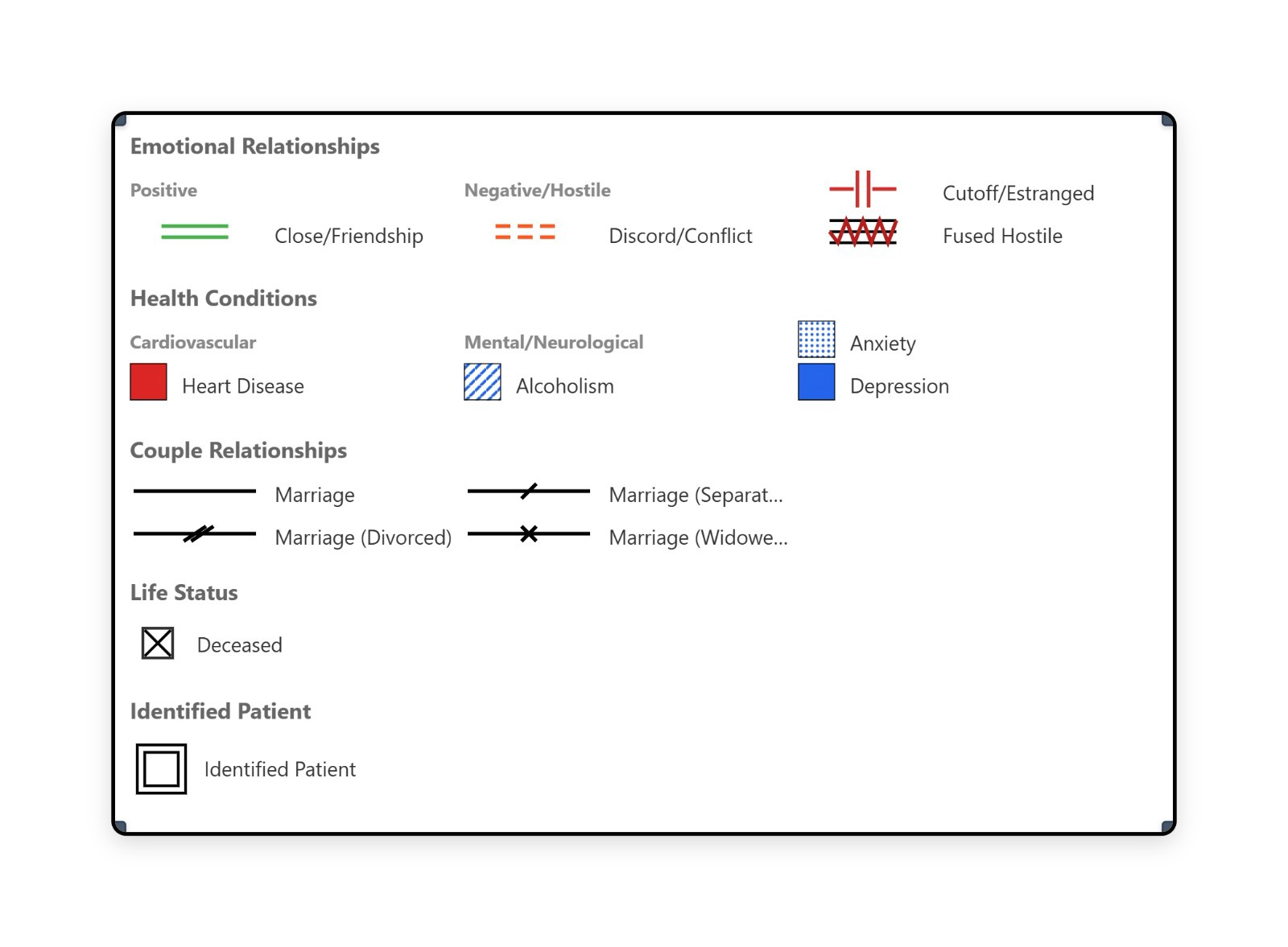
A clear legend ensures that anyone reading your genogram can understand the symbols and notations you've used. This is especially important for collaborative treatment or when sharing genograms with other professionals.
Essential Legend Elements
Basic Symbols
- Male/female symbols
- Age notation method
- Death symbols (X through symbol, with date)
- Birth order indication
Relationship Lines
- Marriage, divorce, separation, cohabitation
- Emotional relationship patterns
- Parent-child connection types
Conditions and Events
- Health condition abbreviations
- Color coding systems
- Special notation methods
WebGeno Advantage
If you're using WebGeno for your genogram creation, the software automatically generates a comprehensive legend based on the symbols you've used. This saves time and ensures consistency across all your genograms.
Positioning Your Legend
- Bottom corner: Most common placement
- Separate page: For complex genograms
- Side margin: When space allows
Step 8: Analyze Patterns
The final step transforms your genogram from a family map into a clinical assessment tool. This is where therapeutic insights emerge and treatment planning begins.
What to Look For
Generational Patterns
- Repetitive themes: Similar issues across generations
- Family roles: Caretakers, rebels, achievers
- Relationship patterns: Conflict styles, intimacy patterns
- Life course similarities: Age at major life events
Structural Patterns
- Family size: Large vs. small families
- Birth order effects: Oldest, youngest, middle child dynamics
- Gender patterns: Treatment of males vs. females
- Loss patterns: Early death, divorce, cutoffs
Functional Patterns
- Communication styles: Open vs. secretive families
- Conflict resolution: How problems are handled
- Support systems: Who helps whom
- Boundaries: Enmeshed vs. disengaged relationships
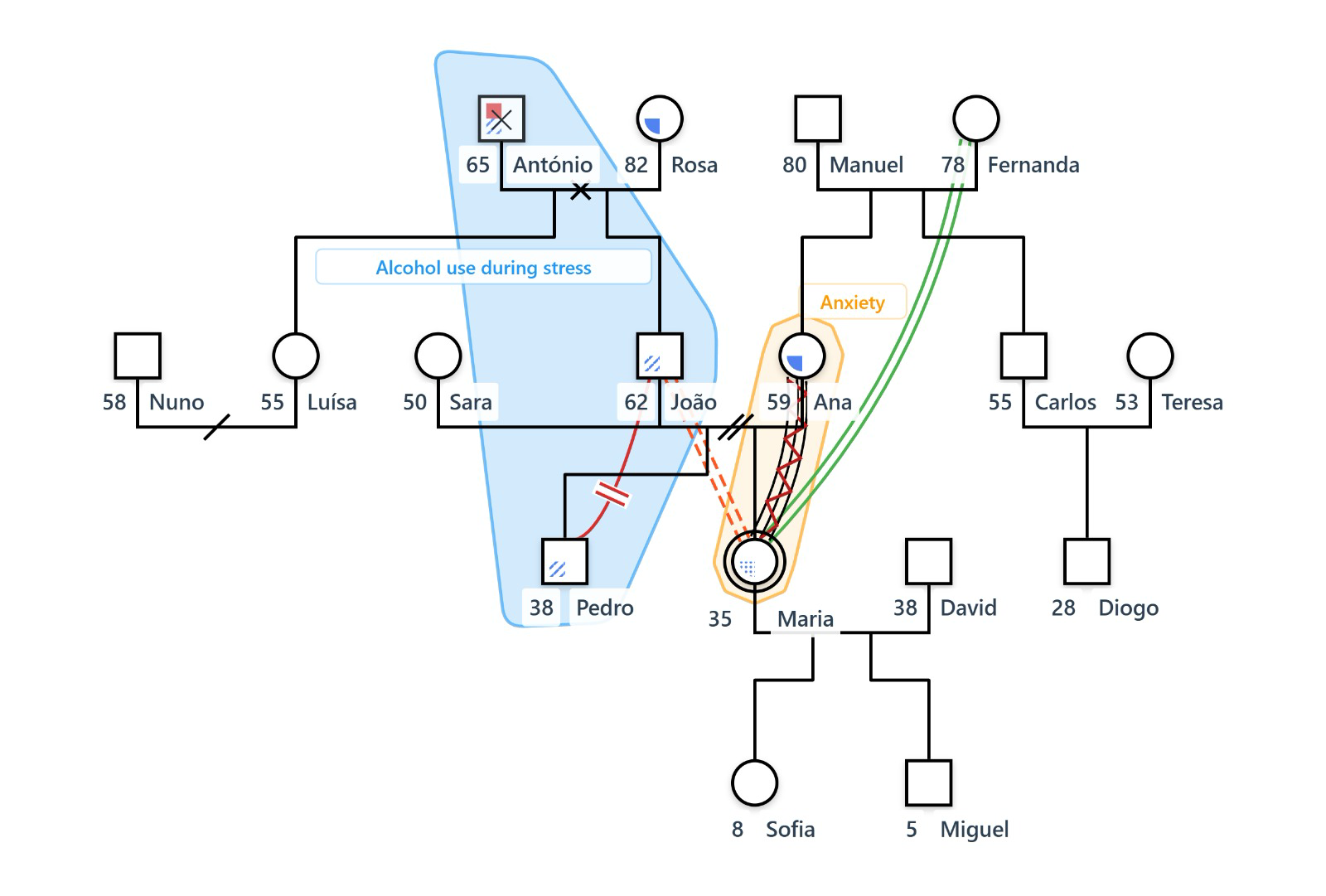
Maria's Pattern Analysis
Looking at Maria's completed genogram, we might notice:
- Generational anxiety: Both Maria and her mother struggle with anxiety
- Divorce pattern: Multiple divorces across generations
- Caretaking roles: Women in the family tend to be caregivers
- Male distance: Men often become emotionally distant or absent
- Substance use: Pattern of alcohol use among males during stress
Clinical Implications
Pattern analysis guides treatment by revealing:
- Potential triggers for current symptoms
- Family strengths and resources
- Intergenerational trauma transmission
- Opportunities for breaking negative cycles
- Cultural and ethnic influences on family functioning
Tips for Clinical Use
Successfully integrating genograms into your clinical practice requires attention to both technical and interpersonal aspects of the assessment process.
Building Rapport During Construction
- Start with facts: Begin with less threatening information (names, ages, occupations)
- Follow the client's lead: Let them guide the pace and depth of disclosure
- Normalize curiosity: "Many families have these kinds of challenges"
- Show interest, not judgment: Maintain therapeutic neutrality
- Validate emotions: "That must have been difficult for your family"
Cultural Sensitivity
Family Structure Variations
- Extended family as primary unit
- Multiple parental figures
- Non-traditional gender roles
- Religious or spiritual influences
- Immigration and acculturation effects
Cultural Assessment Questions
- "How does your cultural background influence your family relationships?"
- "What family traditions or values are most important to you?"
- "How has living in this culture affected your family?"
- "What would your grandparents think about [current situation]?"
Privacy and Confidentiality
- Informed consent: Explain how genogram information will be used
- Storage security: Protect sensitive family information
- Limited disclosure: Only include relevant details
- Client control: Let clients decide what to include
- Family boundaries: Respect family secrets and privacy
Updating Over Time
Genograms are living documents that should evolve:
- Regular reviews: Update at significant treatment milestones
- New information: Add details as they emerge in therapy
- Changing perspectives: Client understanding may shift over time
- Life events: Include births, deaths, marriages, divorces
- Relationship changes: Emotional patterns may evolve
Common Challenges and Solutions
Information Gaps
- Problem: Client doesn't know family history
- Solution: Use dotted lines for uncertain information; explore with available family members
Complex Family Structures
- Problem: Multiple marriages, blended families
- Solution: Use temporal organization; consider separate genograms for different time periods
Overwhelming Emotions
- Problem: Client becomes distressed during construction
- Solution: Take breaks; focus on strengths; validate emotions; consider shorter sessions
Family Resistance
- Problem: Client worried about family reaction
- Solution: Emphasize confidentiality; explain therapeutic purpose; start with less sensitive areas
Try It Now: Create Your First Genogram
Now that you understand the complete process, it's time to put this knowledge into practice. Whether you're working with clients or exploring your own family patterns, creating genograms becomes easier with experience.
Prefer to watch the steps in action? This 2-minute demo builds a first genogram from scratch:
Start Creating Professional Genograms
Skip the paper and put this guide into practice with our free genogram maker — no install, no signup. Building a practice? See our genogram software for therapists for encrypted client sharing and session annotations, or migrate from GenoPro in one click.
Practice Suggestions
- Start with yourself: Create your own genogram to understand the process
- Practice with willing friends: Offer to create genograms for friends or family
- Use case studies: Practice with fictional families from literature or case examples
- Join supervision groups: Discuss genogram findings with colleagues
- Attend workshops: Seek additional training in genogram interpretation
Next Steps in Learning
Continue developing your genogram skills with these resources:
- Master all genogram symbols with our comprehensive symbols guide
- Learn about cultural considerations in cultural genogram assessment
- Explore specialized approaches like trauma and resilience genograms
- Understand the theoretical background in our history of genograms
Conclusion
Creating genograms is both an art and a science. While the technical steps provide structure, the real skill lies in using this visual tool to understand family dynamics, identify patterns, and guide therapeutic intervention.
Remember that every genogram tells a story—not just of individual family members, but of relationships, patterns, and possibilities for change. As you become more comfortable with the process, you'll find that genograms often reveal insights that traditional intake interviews miss.
The eight steps outlined in this tutorial provide a solid foundation for genogram creation. With practice, these steps will become second nature, allowing you to focus on what matters most: using this powerful assessment tool to help individuals and families create positive change.
Start with simple genograms and gradually add complexity as your skills develop. Most importantly, remember that genograms are tools for understanding and healing—use them with compassion, curiosity, and clinical skill.