
Genograms in Social Work Practice
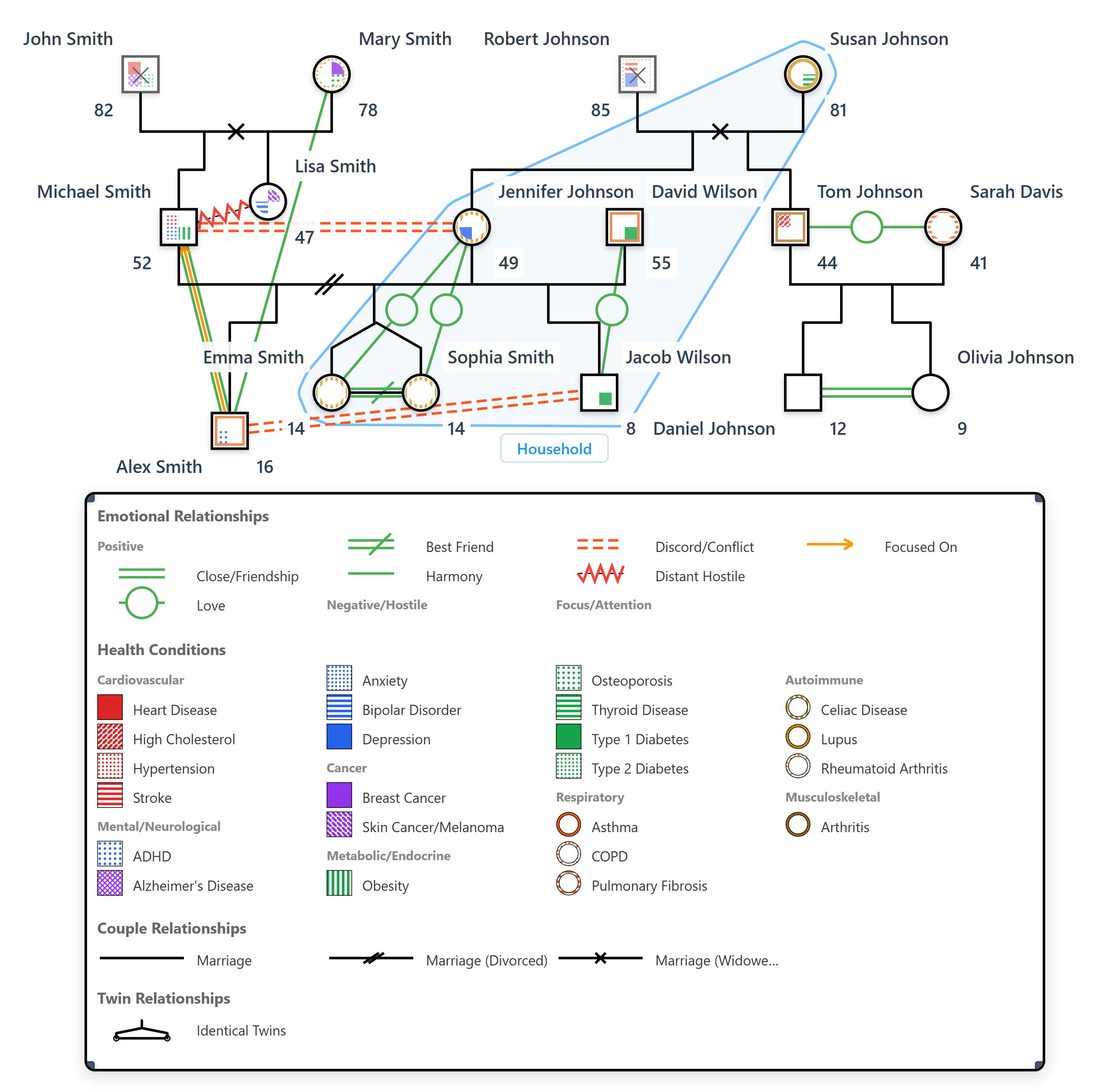
Genograms are essential tools in social work for understanding family systems, identifying intergenerational patterns, and documenting complex family structures. They go beyond simple family trees by mapping health conditions, emotional relationships, and household boundaries.
WebGeno is built specifically for this work — not a generic diagramming tool with genogram templates, but purpose-built software with clinical features social workers actually need:
- Family systems mapping multi-generational with all relationship types
- Health conditions 64 conditions with visual patterns for hereditary tracking
- Case annotations attach notes to any person or relationship
- Encrypted documentation zero-knowledge cloud for case files
- Free for students full Pro access for enrolled BSW/MSW students
How Social Workers Use WebGeno
Family Assessment
Map family structures during intake. Document relationships, living arrangements, and support networks. Identify strengths and risk factors across generations.
Health History Tracking
Track 64 health conditions across generations — mental health, substance use, chronic illness, disability. Visual patterns make hereditary patterns immediately visible.
Case Documentation
Attach clinical annotations to any family member or relationship. Categorize notes as observations, hypotheses, or interventions. Export with numbered references for case files.
Family Meetings
Share genograms with families during sessions. Use as a visual tool to facilitate conversations about family dynamics, patterns, and goals.
Child Welfare
Document custody arrangements, foster placements, and biological/adoptive relationships. Track which children are with which caregivers across placements.
Field Education
Learn genogram creation during your BSW/MSW program with free Professional access. Practice with the same tool you'll use in your career.
Free for Social Work Students
WebGeno provides free Professional access to all enrolled social work students (BSW, MSW, DSW, PhD). This includes cloud sync, PDF/PNG/SVG export, custom health conditions, and GenoPro import.
Features Social Workers Need
All Relationship Types
Biological, adopted, foster, guardian parent-child connections. Marriage, divorce, separation, cohabitation. Identical and fraternal twins. Pregnancy outcomes including miscarriage, stillbirth, and abortion.
13 Visual Patterns
Each health condition has a unique visual pattern — stripes, dots, crosshatch, chevron, and more. Clear differentiation even in black-and-white printing for case file documentation.
Encrypted Cloud Storage
AES-256-GCM end-to-end encryption. Zero-knowledge architecture means only you can read your data. Access genograms from any computer while maintaining complete privacy.
Dynamic Legend
Auto-generated legend shows only the relationships and conditions present in your genogram. Always accurate, always up to date. Included in all exports.
Frequently Asked Questions
What genogram software do social workers use?
Social workers use dedicated genogram software like WebGeno that supports clinical notation, health conditions tracking, and case documentation features not available in generic diagramming tools.
Is there free genogram software for social work students?
Yes. WebGeno provides free Professional access to all enrolled BSW/MSW students. Verify with your .edu email. The free tier (no account needed) also includes unlimited family members, 64 health conditions, and annotations.
How do social workers use genograms?
Social workers use genograms for family assessment, intergenerational pattern identification, case documentation, support network mapping, family meetings, and child welfare placements.
Can I use WebGeno for case documentation?
Yes. WebGeno supports clinical annotations (observations, hypotheses, interventions, follow-ups), PDF export with annotations appendix, and encrypted cloud storage for case files.
Is WebGeno secure enough for client data?
Yes. WebGeno uses zero-knowledge AES-256-GCM encryption. Only you can decrypt your data. You can also save files locally for complete offline privacy.
Does WebGeno support foster and adoptive relationships?
Yes. WebGeno includes biological, adopted, foster, and guardian parent-child connection types with standard genogram notation (solid, dashed, and dotted lines). See our symbols reference.
Start Mapping Family Systems Today
Free forever for core features. Free Pro access for students. Built for social work practice.
Also built for therapists and psychology students